
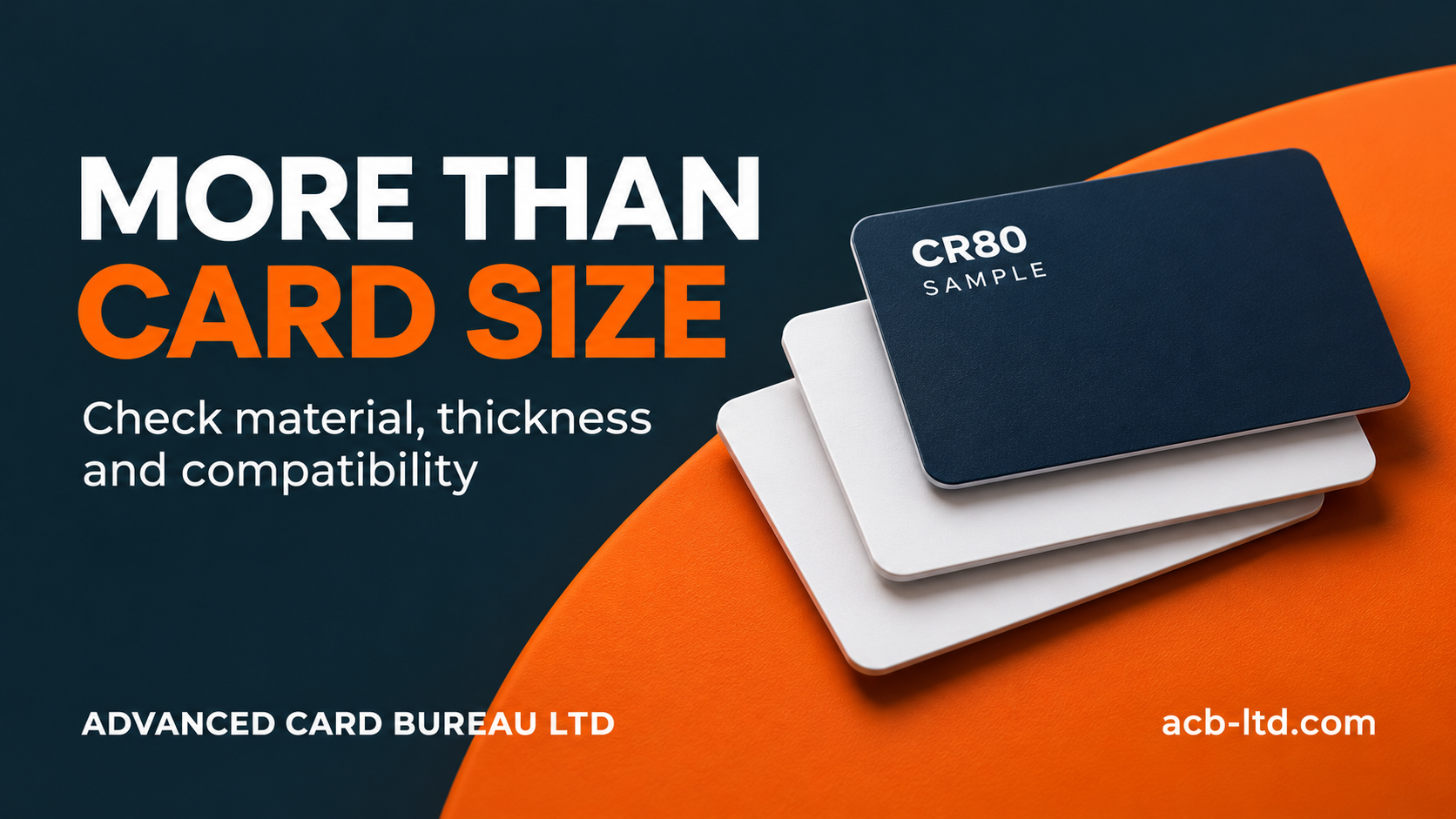
A CR80 card measures 85.60 × 53.98 mm. This is the familiar bank-card-sized format used for many staff ID badges, membership cards and access cards. The dimensions describe the finished card; they do not specify its material, thickness, electronic chip or artwork canvas.
Use this guide to check the card, printer and holder together before ordering blank stock or preparing a printed-card design.
CR80 card dimensions at a glance
| Measurement | Size | What it means |
|---|---|---|
| Long edge | 85.60 mm | Width when the card is landscape |
| Short edge | 53.98 mm | Height when the card is landscape |
| Size in centimetres | 8.560 × 5.398 cm | The same finished card dimensions |
| Approximate size in inches | 3.370 × 2.125 in | Use the units specified by your production template |
| Common card thickness | 0.76 mm / 760 microns | Check the product: CR80 stock is sold in different thicknesses |
CR80 is commonly used for the ISO/IEC 7810 ID-1 format. ISO’s identification-card standard covers physical characteristics, while manufacturers specify which stock their printers accept. For example, Evolis lists the CR80 format as 53.98 × 85.60 mm.
Is a portrait ID card a different size?
No. A standard portrait badge turns the same CR80 card through 90 degrees: its displayed width is 53.98 mm and its height is 85.60 mm. Choose the orientation around the photograph, name and information that must be easy to read.
Match that orientation to the ID card holder. Check the holder’s stated insert dimensions and capacity, particularly if you need two cards, a thicker credential or a protective sleeve. A holder’s outside dimensions are not its usable card space.
What do 760 micron and 30 mil mean?
760 microns equals 0.76 mm. “Mil” means one thousandth of an inch, so 30 mil converts to 0.762 mm and is commonly used as the nominal description for 0.76 mm stock. It does not mean 30 millimetres.
Size and thickness are separate checks. A card can have the CR80 footprint while being thinner, thicker or constructed differently from your current stock. Adhesive-backed cards also need their own media and mounting checks; do not treat their liner and finished mounted thickness as interchangeable with a standard card.
ACB’s premium blank white PVC cards are listed as CR80, 760-micron stock. Compare the exact listing and pack option before ordering.
Will any CR80 card work in my printer?
The size alone is not enough. Match these details to the manufacturer’s specification for your exact printer:
- Thickness and feed settings: check the permitted range and any required adjustment.
- Material and surface: confirm the approved card construction and printing surface.
- Ribbon and process: match the card to direct-to-card or retransfer printing and any separate lamination process.
- Card features: check magnetic stripes, signature panels, chips and any areas that must remain clear.
- Encoding: confirm the precise card technology, encoder and software requirements separately from printing.
Manufacturer limits vary. The Evolis Zenius 2 specification, for example, lists a thickness range of 0.25–0.76 mm with gauge adjustment. That is a specification for that printer, not a promise that all card printers accept the same range.
For an access-control job, “CR80” describes the card shape, not the credential technology. NXP’s MIFARE DESFire EV3 specifications, for example, separately define its contactless interface and memory options. Match the exact system requirement before selecting MIFARE cards or other access credentials.
What size should CR80 artwork be in pixels?
A calculation from the nominal finished size at 300 pixels per inch gives approximately 1011 × 638 pixels in landscape orientation. This is a size conversion, not a universal printer template.
The required canvas can differ by printing process and driver. Magicard’s official card templates specify 1013 × 642 pixels at 300 dpi for its direct-to-card templates and 1036 × 663 pixels for the listed CR80 retransfer templates. Use the template for the actual printer and process rather than resizing a design solely to a generic pixel calculation.
Does CR80 artwork need bleed?
Use the production template agreed for the job. A printed sheet that will be trimmed to cards and a desktop printer that prints onto pre-cut cards have different artwork requirements.
If a job specifies a finished size of 85.60 × 53.98 mm and 3 mm bleed on every edge, the artwork canvas is 91.60 × 59.98 mm: add 6 mm to each dimension. If the supplied template uses a different trim size or bleed, follow that template instead. Keep important text, photographs and codes within its safe area, and allow for any stripe, chip, signature panel or slot.
For ACB photo ID card printing, confirm the job template and approve the proof before production. A screen preview alone does not establish the final print size or machine-readable-code quality.
Choose the right card for the job
- Blank white cards for an approved in-house personalisation process.
- Coloured plastic cards when the stock colour forms part of the design; check contrast and ribbon suitability.
- Magnetic stripe cards when your system requires the specified stripe and encoding.
- Finished photo ID cards when you want ACB to supply personalised badges.
When asking ACB to check a specification, provide the printer model, existing card reference, required thickness, quantity and any encoding or holder requirements. Those details are more useful than “credit-card size” alone.
Technical references
Checked on 8 November 2026: ISO/IEC 7810:2019 — Identification cards: physical characteristics; Evolis Zenius 2 technical specifications; Magicard card templates; and NXP MIFARE DESFire EV3 specifications. Always check the current manual and job template for the equipment and stock you will use.
