
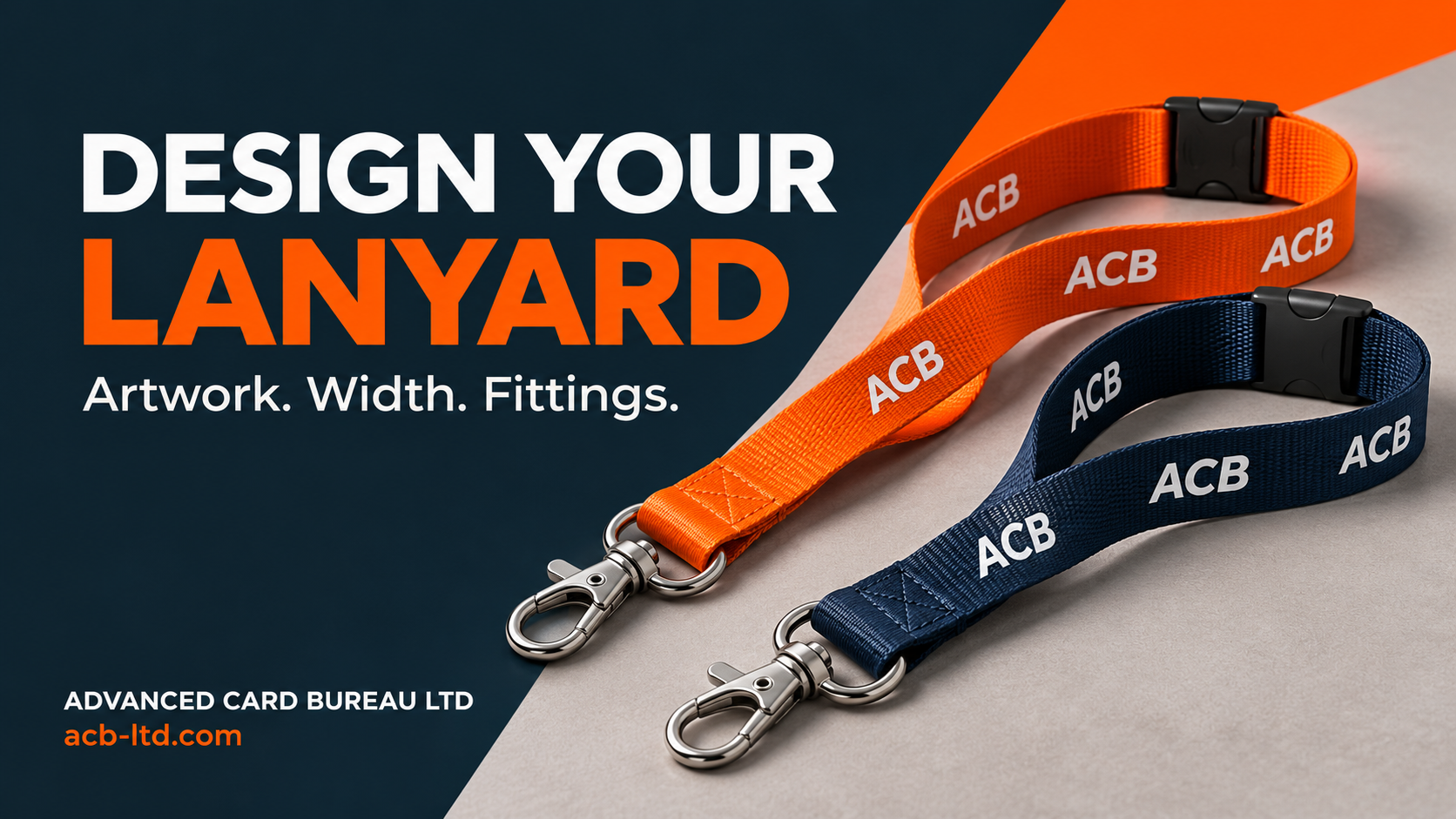
To design a lanyard, decide how it will be worn, choose the strap width and print method, prepare a readable repeating design and confirm the fittings before approving the proof. The artwork and the attachment need to work together with the badge or pass.
This guide helps you prepare a brief for ACB bespoke printed lanyards. It is useful for staff identification, visitor schemes, conferences and other events where the same design will be worn by many people.
1. Start with the wearer and the badge
Write down who will wear the lanyard, what it will carry and the setting in which it will be used. A staff badge, a larger event pass and a double-sided holder can have different attachment needs. Check the slot or hole on the actual holder before choosing the clip.
Confirm any breakaway requirement with the organisation responsible for the setting. A detachable buckle releases a lower section for convenience; it should not be treated as the same feature as a safety breakaway. Choose the required configuration and review it in the specification.
2. Give the design enough width
ACB’s bespoke range offers 10, 15, 20 and 25 mm widths. A wider strap provides more room for a logo and wording, but the useful print area still depends on the production template. Do not stretch a logo to fill the strap or assume the artwork can use every millimetre.
| Width | Useful starting point for the brief |
|---|---|
| 10 mm | A compact logo and short wording; check small details carefully |
| 15 mm | An everyday layout with a logo and concise text |
| 20 mm | More room for longer wording or a larger brand mark |
| 25 mm | A broader design with greater visual presence |
These are layout starting points, not guaranteed minimum text sizes. Ask for the template for the chosen print process, then assess the proof at the intended scale. If a logo has fine lines or a small strapline, a simplified approved version may read more clearly.
3. Build a repeat that works when worn
Choose the message that needs to be recognised first: usually the organisation or event name. Decide how the logo and wording repeat, how much space separates them and what should appear on each printed side. Long web addresses and several competing messages can make the strap difficult to read.
- Supply the original logo or the best available artwork file.
- Include exact wording and brand colour references.
- Keep important details clear of the ends, seams and fittings shown on the template.
- Check the direction of the wording when the lanyard is worn.
- State whether both sides need printing and whether they use the same design.
4. Match the print method to the artwork
Full-colour dye sublimation suits multicolour designs, gradients and continuous artwork. Screen printing is another route for clear lettering and logos in a limited number of colours. Confirm the available material, print method and colour specification together in the configurator or quotation.
A screen preview is not a physical colour standard. Supply your brand references and ask how colour will be assessed for the chosen material and process. If a colour match is critical, discuss the appropriate approval route before placing the main order.
5. Count designs as well as lanyards
The current ACB bespoke minimum is 100 lanyards overall, with at least 50 per design. For example, an illustrative order for 150 could comprise 100 “Staff” and 50 “Visitor” lanyards. A split of 125 and 25 would not meet the stated per-design minimum. Confirm unusual quantity splits before ordering.
List the width, clip and breakaway for each design, particularly if different groups need different fittings. Keep holders, passes and any badge reels in the same brief so the complete set can be checked.
6. Approve more than the logo
- Check spelling, logo proportions, colour references and repeat spacing.
- Confirm width, printed sides and the quantity assigned to each design.
- Match the clip to the holder or pass and check any breakaway or buckle requirement.
- Confirm which file and proof version are approved.
- Agree the delivery requirement and the production schedule after proof approval.
ACB accepts PDF, PNG or JPEG artwork uploads up to 10 MB on the bespoke lanyard page; a print-ready PDF is preferred. You can also select the option to send artwork later. Production turnaround starts after artwork approval, so allow time for preparing and checking the proof.
Your lanyard order brief
Send the intended use, total quantity, design split, width, material and print preference, logo files, exact wording, colour references, required fittings and delivery date. Include a photo or reference for an existing holder if the attachment needs checking.
Configure your bespoke lanyards, compare ID card holders or ask ACB to review your brief.
Prepared by Advanced Card Bureau Ltd · 8 November 2026.
